
AI scaling fails when initiatives move faster than people, workflows, and governance can absorb them.
Enterprise AI adoption is no longer waiting for permission.
Employees are using AI tools. Departments are testing copilots and automation. Executives are funding pilots. Vendors are embedding AI into existing platforms. Boards are asking how fast the organization can move.
But the more important question is not whether the organization is using AI.
The more important question is whether the organization is ready to operate with AI.
That depends less on tool access alone and more on people capability: whether employees, managers, reviewers, and department leaders can apply AI responsibly inside real work.
If that capability is not measured, organizations risk scaling AI activity before they understand whether people can use AI safely, consistently, and with measurable value.
This is why people capability measurement should come before broad AI scaling.
The scaling problem is not just technology
AI adoption is accelerating across business. Stanford’s 2025 AI Index reports that 78% of organizations used AI in 2024, up from 55% the year before. Generative AI investment also continued to grow.[1]
But wider use has not automatically produced scaled impact. McKinsey’s 2025 State of AI research found that 88% of respondents say their organizations regularly use AI in at least one business function, yet only about one-third report that their companies have begun scaling AI programs across the organization. McKinsey also found that only 39% of respondents attribute any level of enterprise-wide EBIT impact to AI.[2]
That gap matters.
It suggests that many organizations are moving from AI experimentation to AI activity, but not yet from AI activity to AI operating maturity.
The reason is simple: scaling AI is not the same as buying AI tools. Scaling AI changes how work is performed, reviewed, governed, measured, and improved. That requires people capability.
Why people capability is the missing layer
Many AI programs begin with a technology view.
Leaders ask:
- Which AI tools should we approve?
- Which use cases should we fund?
- Which vendors should we evaluate?
- Which pilots should move into production?
- Which departments should adopt AI first?
Those are necessary questions. But they are incomplete.
A stronger enterprise readiness question is:
Do the people who will use, review, manage, and govern AI-enabled work have the capability to do so responsibly?
That question includes more than AI literacy. It includes practical operating capability:
- Can users frame AI-supported tasks clearly?
- Can they check outputs against evidence or approved sources?
- Can they recognize when AI output requires human review?
- Can they identify privacy, compliance, security, or customer-impact risk?
- Can managers oversee AI-enabled workflows?
- Can departments redesign work instead of simply adding AI to old processes?
- Can leaders see where capability is improving and where risk remains?
Without answers to those questions, scaling AI becomes a management gamble.
Individual readiness is the smallest unit of enterprise readiness
Enterprise AI adoption happens through individual behavior.
Every AI-enabled workflow depends on people making judgment calls. A user decides what to ask. A reviewer decides whether an output is acceptable. A manager decides whether AI changes the workflow. A data owner decides what information can be used. A risk leader decides what controls are needed. A department head decides whether the use case is ready to scale.
That is why individual readiness matters.
If individual users cannot apply AI responsibly, then the department is not truly ready. If managers cannot oversee AI-enabled work, then the operating model is not ready. If employees do not know when to escalate risk, then governance exists on paper but not in behavior.
People capability is therefore not a soft issue. It is part of enterprise infrastructure.
Department readiness depends on people capability
AI does not scale evenly across an organization.
One department may have strong leadership, clear workflows, good data, and capable users. Another may have strong enthusiasm but weak process ownership. A third may have good use cases but poor data readiness. A fourth may have trained employees but unclear review expectations.
That is why enterprise AI readiness requires two connected views:
Individual capability
Can people use AI responsibly in their roles?
This includes AI literacy, task framing, prompt design, evidence checking, human review, governance awareness, and adoption behavior.
Department readiness
Can the department absorb AI-enabled change?
This includes workflow clarity, data readiness, leadership support, process ownership, risk controls, systems fit, and manager oversight.
A department cannot be judged ready just because it has AI use cases. It also needs the operating conditions to support those use cases.
The workflow problem: AI value requires work redesign
The difference between AI experimentation and AI value often appears at the workflow level.
BCG’s 2025 AI at Work research found that while more than three-quarters of leaders and managers use generative AI several times a week, regular use among frontline employees has stalled at 51%. BCG also argues that simply introducing AI tools into existing work is not enough; the larger value comes when organizations reshape workflows end to end.[3]
This is the point many organizations miss.
AI does not create durable value just because people use it. AI creates value when the work changes in a controlled and useful way.
That may mean:
- removing low-value manual steps
- redesigning handoffs
- adding review points
- clarifying decision rights
- changing what managers inspect
- defining where human judgment is required
- creating new quality controls
- tracking whether the work actually improved
Those changes require people capability at multiple levels. Users need practical AI skills. Managers need oversight capability. Departments need process discipline. Leadership needs visibility into where AI should scale and where foundations are weak.
The data and governance problem
People capability also connects directly to data and governance.
AI-supported work depends on what information people use, what outputs they trust, and what decisions they make from those outputs. If employees do not understand data quality, source reliability, privacy boundaries, or review expectations, then AI use can scale risk as quickly as it scales productivity.
Gartner has warned that many organizations are not ready on this front: 63% either do not have, or are unsure whether they have, the right data management practices for AI. Gartner also predicts that through 2026, organizations will abandon 60% of AI projects unsupported by AI-ready data.[4]
This is not only a data-team problem.
People need to know when data is appropriate for AI-supported work, when evidence is insufficient, when sensitive information should not be used, and when human review is required.
NIST’s AI Risk Management Framework is designed to help organizations manage AI risks to individuals, organizations, and society. That framing reinforces the same point: AI governance has to become operational. It cannot remain a policy document that employees do not know how to apply.[5]
The operating-model problem
Scaling AI changes the operating model.
It changes who does the work, who reviews the work, who owns the risk, who approves exceptions, who measures value, and who intervenes when something goes wrong.
This is where people capability becomes a leadership issue.
Deloitte’s State of AI in the Enterprise research found that worker access to AI rose significantly and that expectations for scale are high. But it also says many organizations are using AI at a more surface level, with little or no change to existing processes, and identifies insufficient worker skills as a major barrier to integrating AI into workflows.[6]
That finding is important because it shows the gap between access and operating change.
Organizations may provide tools, training, and pilots, but still fail to redesign roles, workflows, incentives, and controls. People capability measurement helps expose that gap.
What organizations should measure before scaling AI
Before scaling AI broadly, organizations should measure capability across six areas.
01
AI task capability
Can people frame AI-supported tasks clearly? This includes defining the goal, audience, context, constraints, expected output, and acceptable level of uncertainty.
02
Workflow capability
Can people identify where AI fits into real work? This includes understanding which steps change, which steps remain human-led, and where review or escalation is required.
03
Evidence capability
Can people verify AI output? This includes checking sources, identifying unsupported claims, recognizing weak assumptions, and knowing when expert review is needed.
04
Risk and governance capability
Can people recognize risk in context? This includes privacy, compliance, security, fairness, customer impact, intellectual property, and policy boundaries.
05
Managerial oversight capability
Can managers supervise AI-enabled work? This includes setting expectations, reviewing output quality, identifying misuse, coaching teams, and tracking whether work improves.
06
Adoption capability
Can people change how work gets done? This includes new habits, team routines, role clarity, feedback loops, and the willingness to redesign work rather than simply use AI as a side tool.
Together, these areas show whether the workforce can operate with AI, not just experiment with it.
A practical scaling decision model
People capability measurement helps leaders make better scaling decisions.
| Readiness signal | What it means | Leadership decision |
|---|---|---|
| High people capability, strong department readiness | Users can apply AI responsibly, workflows are clear, data and governance are in place. | Scale with monitoring |
| High people capability, weak department readiness | Users are capable, but workflows, systems, data, or governance are not ready. | Fix operating conditions before scale |
| Low people capability, strong department readiness | The department has good foundations, but users need enablement. | Target training, coaching, and reassessment |
| Low people capability, weak department readiness | Both workforce and operating conditions are immature. | Do not scale yet; build readiness first |
This is the value of measurement. It prevents leaders from treating all departments the same.
Some areas are ready to move. Some need enablement. Some need workflow redesign. Some need data or governance remediation before AI should scale.
Why training alone is not enough
Training is necessary, but it is not a readiness system.
Training can create awareness. It can increase confidence. It can introduce tools, policies, examples, and basic prompting skills.
But training does not automatically show whether people can apply AI safely in the work itself.
A training completion report cannot answer:
- Can users judge whether an AI output is reliable?
- Can managers identify weak AI use inside a team?
- Can departments redesign workflows around AI?
- Can employees distinguish low-risk from high-risk use cases?
- Can teams apply governance expectations in daily behavior?
- Can leadership see whether capability improved after enablement?
This is why training should be connected to measurement.
The sequence should be:
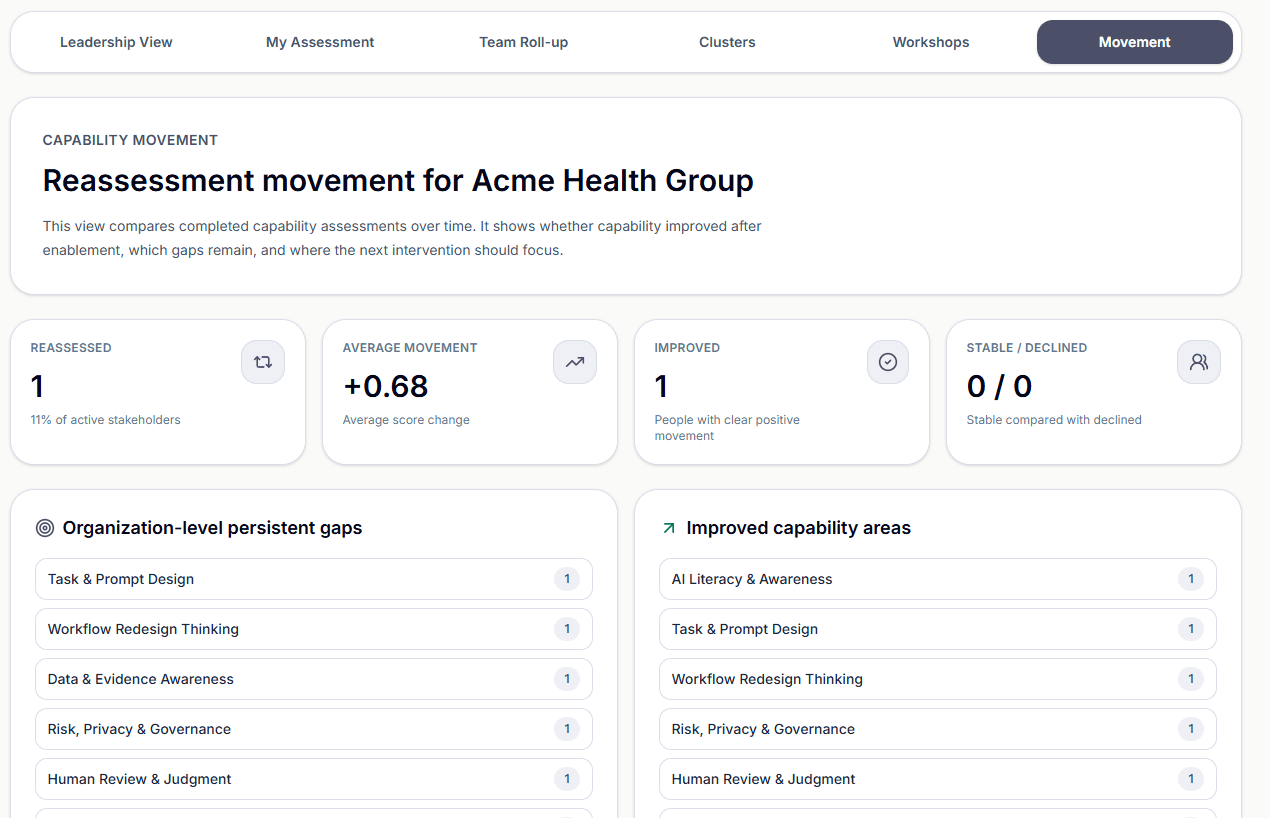
- Measure current capability.
- Target enablement to the gaps.
- Reassess after training, coaching, or workflow redesign.
- Connect improvement to department readiness and operating-model change.
That turns AI enablement from an activity into a management system.
The workforce issue is larger than AI
AI capability measurement also fits into a broader workforce transformation challenge.
The World Economic Forum’s Future of Jobs Report 2025 is based on input from more than 1,000 employers representing over 14 million workers. It identifies technological change as one of the major forces expected to shape jobs and skills through 2030.[7]
For organizations, this means AI readiness is not a one-time training problem. It is an ongoing capability-management problem.
Roles will change. Skills will change. Review responsibilities will change. Managers will need to supervise work that is partly human and partly AI-supported. Departments will need to know which processes can be redesigned, which controls must be strengthened, and which people need targeted support.
A one-time AI training program cannot manage that complexity.
Capability measurement can.
From AI initiatives to AI operating maturity
The organizations that scale AI responsibly will not be the ones with the most pilots or the most tools. They will be the ones that build a management system around AI-enabled work.
That system needs four connected views.
People capability
Can individuals use AI responsibly in real tasks?
Department readiness
Can teams absorb AI-enabled change?
Initiative quality
Are AI use cases tied to value, risk, workflow fit, and ownership?
Operating-model change
Are roles, reviews, controls, governance, and performance measures changing with the work?
When these views are disconnected, AI scaling becomes fragmented. When they are connected, leaders can see where to move, where to slow down, and what needs to be fixed.
That is the real reason to measure people capability before scaling AI.
Are our people, departments, and operating model ready for AI-enabled work — or are we only ready to experiment?
Sources
- [1] Stanford HAI — The 2025 AI Index Report
- [2] McKinsey — The State of AI: Global Survey 2025
- [3] BCG — AI at Work: Momentum Builds, but Gaps Remain
- [4] Gartner — Lack of AI-Ready Data Puts AI Projects at Risk
- [5] NIST — AI Risk Management Framework
- [6] Deloitte — State of AI in the Enterprise
- [7] World Economic Forum — The Future of Jobs Report 2025