
Measure AI readiness — for yourself or your organization.
Kovalba helps professionals and leadership teams understand AI capability, readiness gaps, governance exposure, and what needs to be fixed before scaling AI-enabled work.
Free
personal assessment
8
AI capability dimensions
6
platform capabilities
Executive AI readiness view
Choose your starting point
Start individually, or assess the organization.
The public assessment creates a low-friction entry point. The organizational platform connects individual capability with department readiness, AI initiatives, governance, and fix planning.
For professionals
Take the individual AI operating capability self-assessment and get your personal readiness profile, strongest area, growth opportunity, and recommended next step.
Take free assessmentFor organizations
Assess department readiness, workforce capability, AI initiatives, governance exposure, enablement needs, and reassessment movement in one management view.
Explore organizational platformStart with your own AI operating capability profile.
Take the assessment and get a practical view of how ready you are to use AI responsibly in real work — not just whether you know how to prompt a tool.
The problem
AI activity is rising. Operating discipline is not.
Readiness is unclear
Departments assess AI opportunities differently, making prioritization weak and inconsistent.
Use cases are disconnected
AI ideas are proposed without a common view of ownership, value, workflow, data, and risk.
Training is generic
People capability is often treated as course attendance instead of measurable workforce readiness.
Leadership lacks movement evidence
Executives cannot easily see whether enablement improved capability after intervention.
What the assessment measures
8 AI operating capability dimensions.
The individual assessment looks at practical AI use in real work: task framing, workflow thinking, evidence, review, risk awareness, adoption, and oversight.
AI literacy and awareness
Understand what AI can and cannot do, where it helps, where it fails, and why human judgment remains necessary.
Task and prompt design
Frame AI tasks clearly with context, constraints, examples, audience, and expected output.
Workflow redesign thinking
Identify where AI fits into real workflows, what changes, and what should remain human-led.
Data and evidence awareness
Use approved information, understand data quality, and verify AI output against evidence.
Risk, privacy, and governance
Recognize privacy, fairness, compliance, customer-impact, and accountability risks.
Human review and judgment
Know when AI output needs review, verification, escalation, or expert judgment.
Adoption and change behavior
Adjust work habits, share learning responsibly, and participate in AI-enabled change.
Management and oversight awareness
Understand ownership, decision rights, escalation paths, controls, and review expectations.
The Kovalba readiness system
6 connected platform capabilities, one fix-plan view.
Kovalba does not only show readiness status. It connects capability, department readiness, initiatives, governance, workshops, and reassessment into a practical view of what needs to be fixed.
Capability assessment
Measure practical AI operating capability across literacy, prompting, workflow redesign, evidence use, governance, human review, adoption, and oversight.
Department readiness
Assess whether departments have the leadership, workflow, data, systems, governance, adoption, and scaling readiness required for AI-enabled work.
AI initiative planning
Turn scattered AI ideas into structured initiatives with value hypothesis, owners, KPIs, data needs, systems touched, risks, and dependencies.
Governance and oversight
Expose privacy, human review, accountability, risk, policy, and control gaps before AI use cases are scaled across teams.
Workshop roadmap
Convert weak scores and repeated gaps into practical enablement themes, workshop audiences, objectives, and facilitator cues.
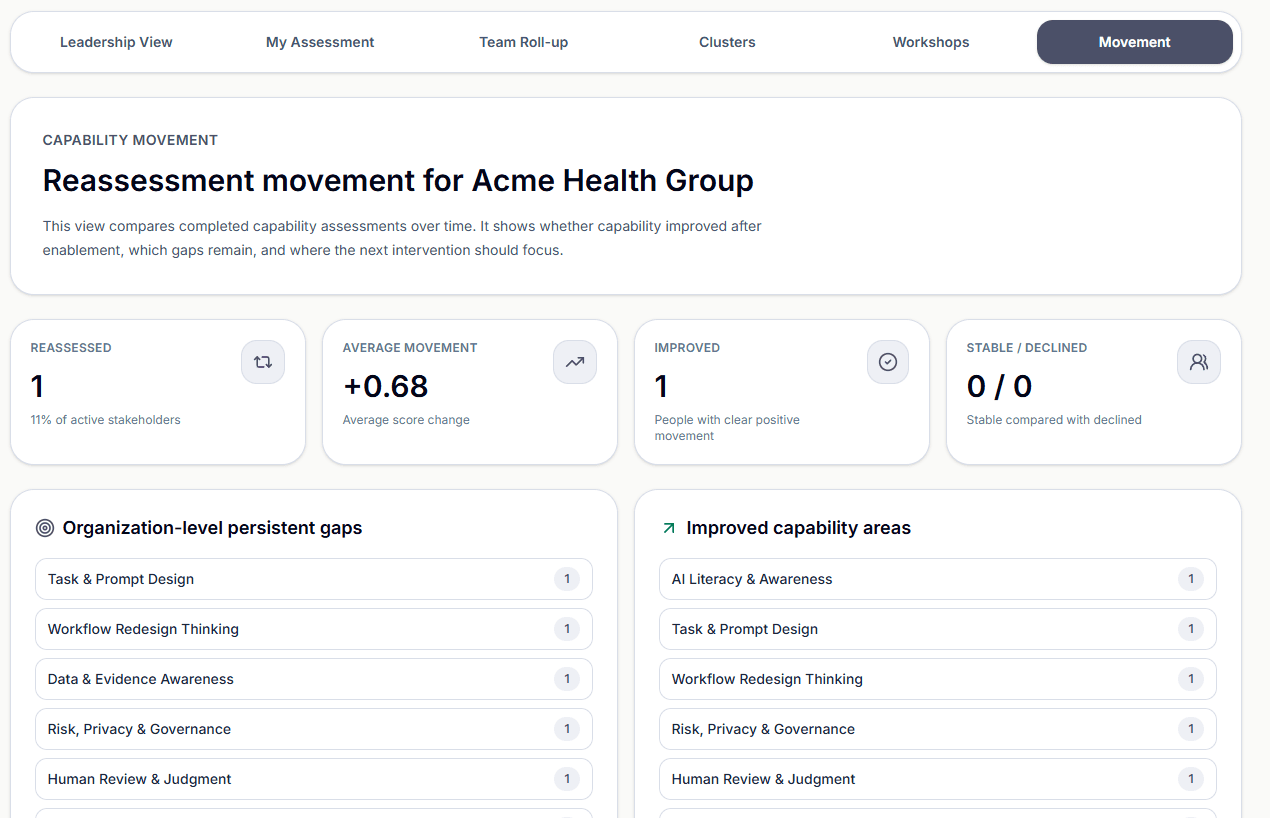
Reassessment movement
Show whether enablement improved capability over time by tracking improved areas, persistent gaps, new gaps, and next focus areas.
Platform
One management layer for readiness, initiatives, people capability, and enablement.
Kovalba is designed for organizations that are past AI awareness but not yet operating with disciplined, measurable, department-led AI adoption.
Readiness
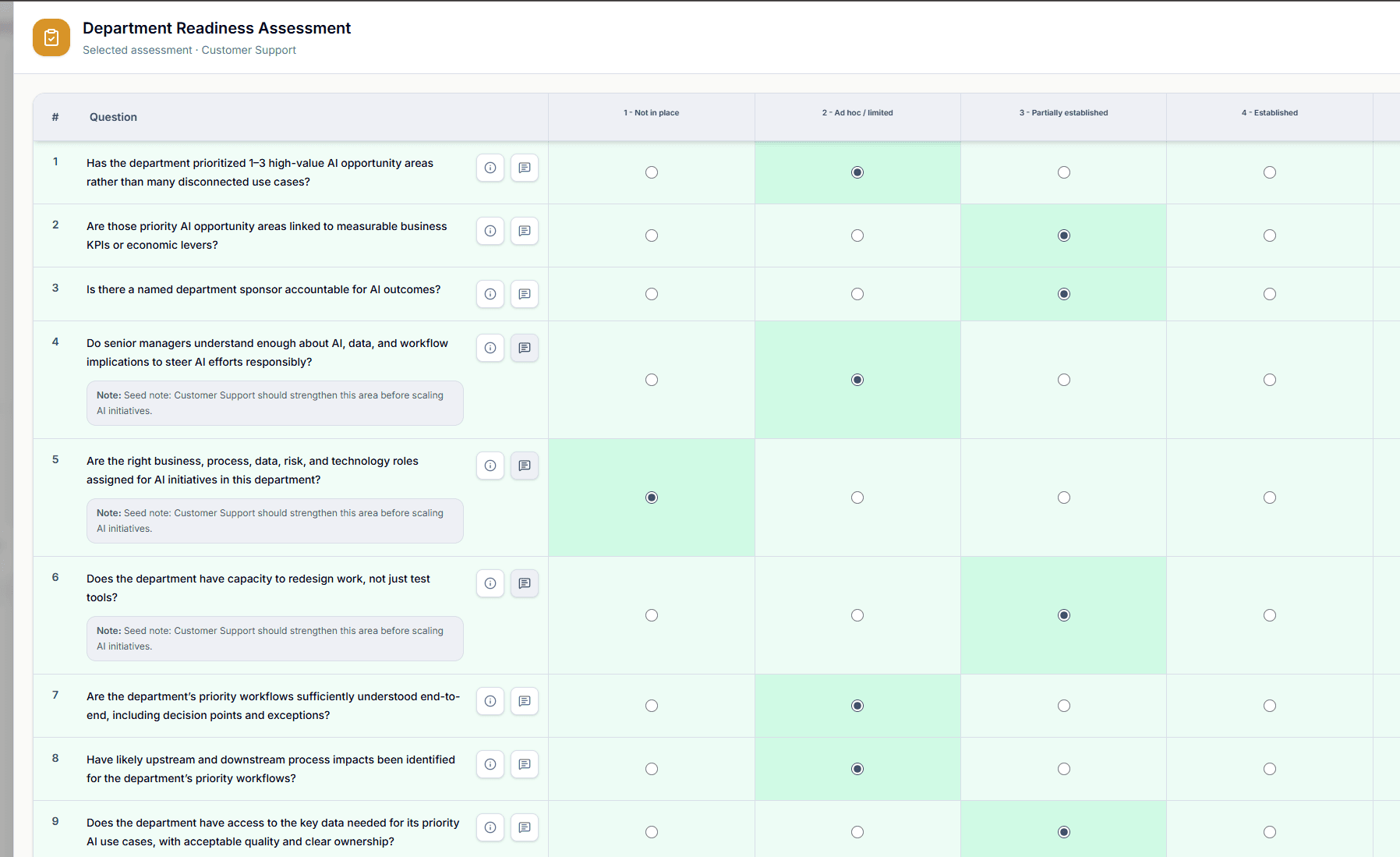
Department readiness diagnostics
Assess whether each department has the leadership, data, workflow, systems, governance, adoption discipline, and scaling readiness required for AI-enabled work.
Initiatives
AI initiative planning
Move AI ideas out of informal discussion and into a structured pipeline with business value, owners, stakeholders, risks, dependencies, KPIs, and implementation readiness.
People
Workforce capability assessment
Measure practical AI operating capability by user, role, department, dimension, and cluster — not abstract AI awareness or generic training completion.
Movement
Targeted enablement and reassessment
Convert capability gaps into workshop themes, then measure whether enablement changed capability through reassessment movement over time.
How it works
A practical operating flow for AI enablement.
Assess the organization, structure initiatives, measure capability, plan enablement, and reassess movement — in one connected management flow.
Map the organization
Define departments, stakeholders, governance roles, sponsors, reviewers, and operating ownership.
Assess readiness
Run department diagnostics to expose where AI adoption can proceed and where remediation is required first.
Structure AI initiatives
Capture use cases with business value, workflow fit, systems touched, data needs, human oversight, and risk.
Measure people capability
Assess how users understand AI tasks, review outputs, redesign workflows, apply evidence, and manage governance exposure.
Plan enablement
Group similar capability gaps into clusters and generate workshop recommendations for each audience.
Track movement
Reassess over time to show improved areas, persistent gaps, new gaps, and the next enablement focus.
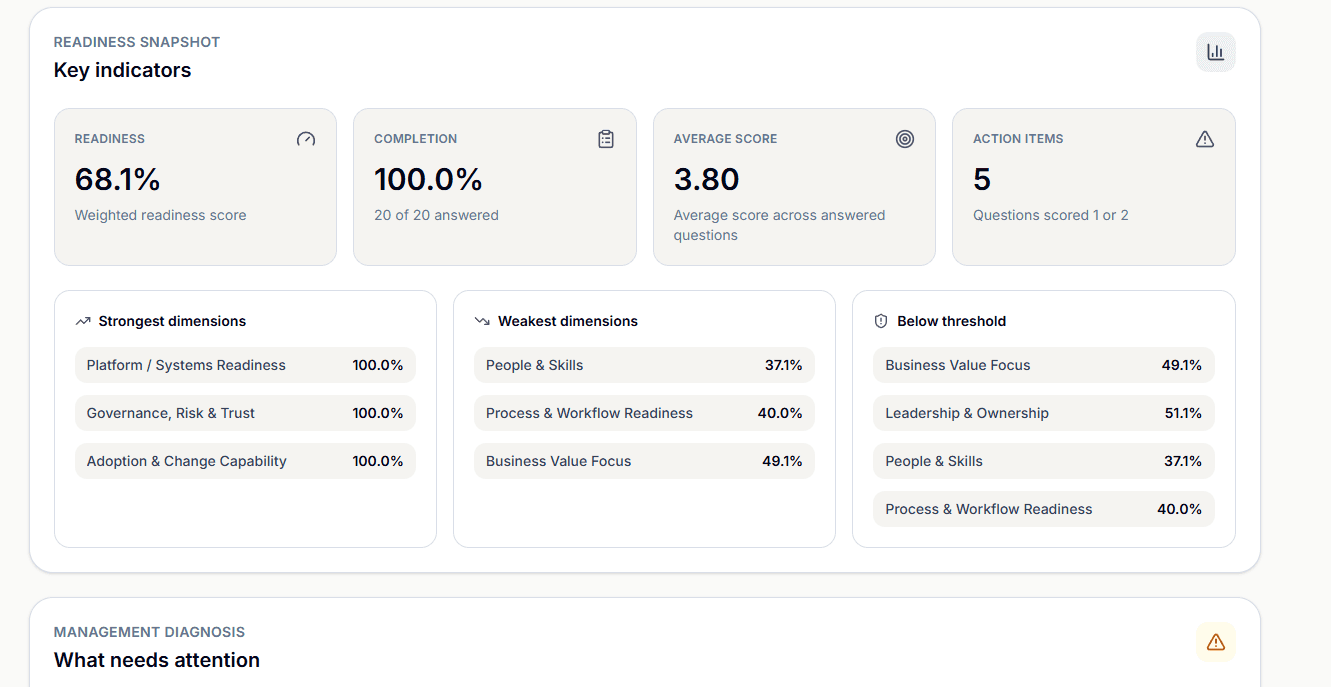
Readiness diagnostics
See where AI adoption is ready — and where it is exposed.
Kovalba turns department-level readiness into a visible operating map. Leadership can compare readiness across dimensions such as leadership support, data, workflow, systems, governance, adoption, scaling, and learning discipline.
- Department readiness scoring
- Dimension-level gap profile
- Heatmaps for leadership review
- Remediation focus by department
Kovalba workspace
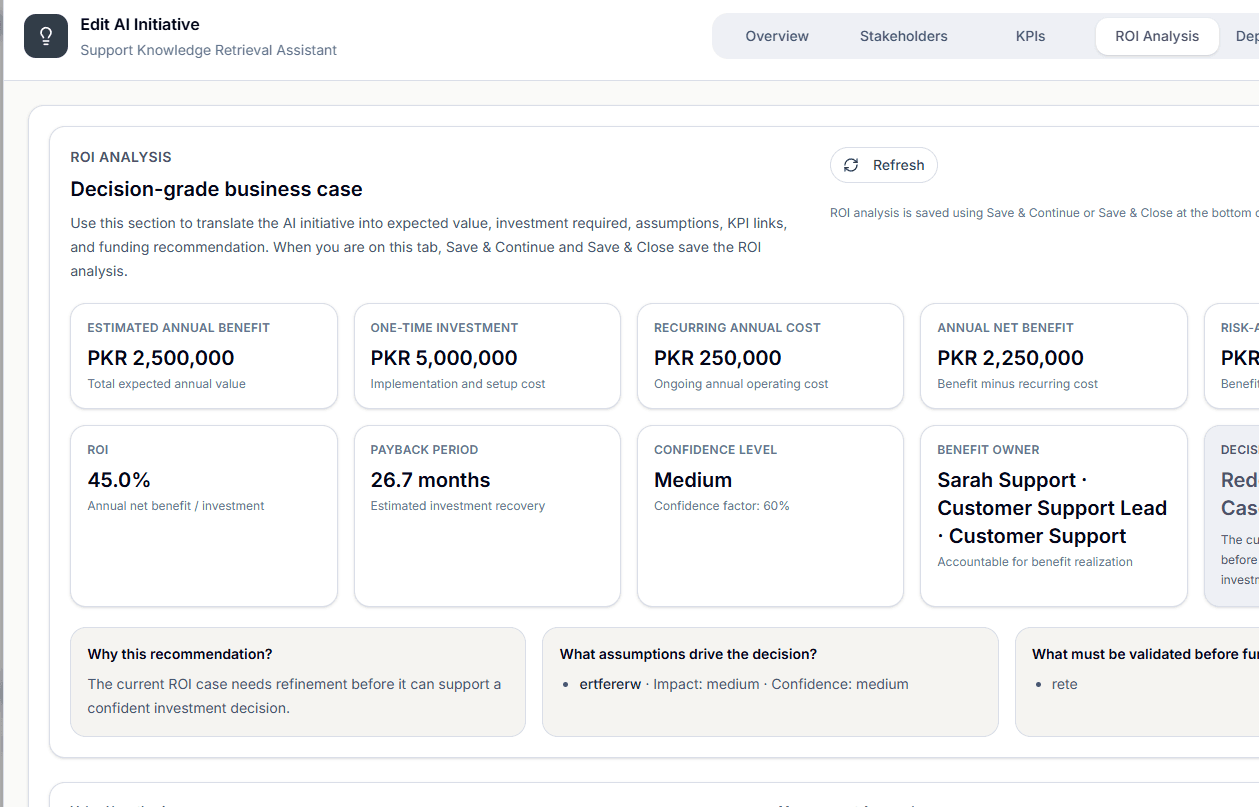
Initiative control
Turn scattered AI ideas into a governed initiative pipeline.
Most organizations have AI ideas before they have AI discipline. Kovalba structures each initiative around value, scope, workflow, owners, data, systems, risks, dependencies, KPIs, and human oversight.
- Business value and KPI hypothesis
- Named owners and stakeholders
- Workflow and system dependencies
- Risk and governance visibility
Kovalba workspace
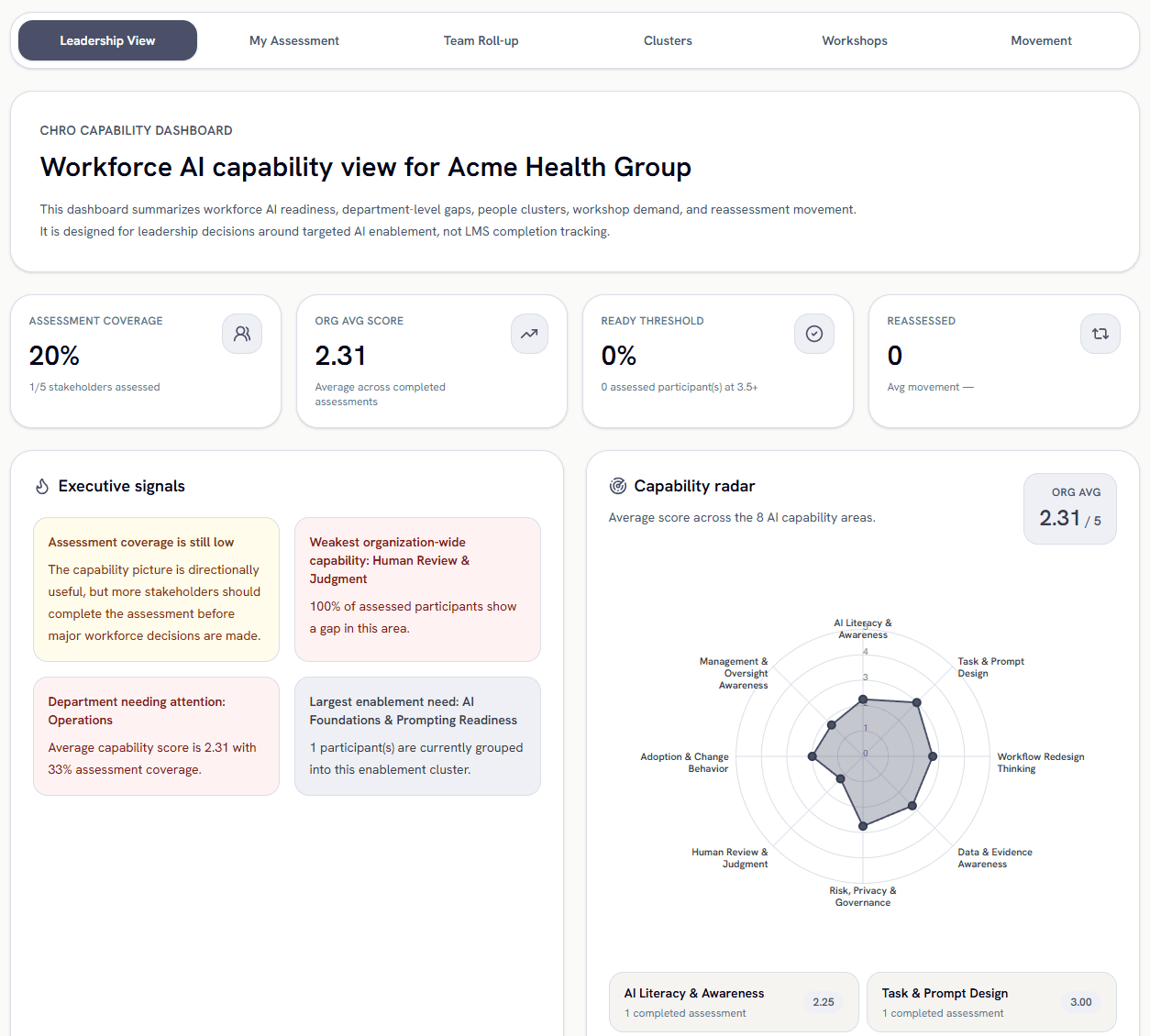
People capability
Measure practical AI capability, not generic AI enthusiasm.
Kovalba assesses how people understand AI-enabled work: where AI fits, what remains human-led, how outputs should be reviewed, where governance matters, and how capability changes over time.
- Capability by user, role, and department
- Weakest dimensions and recurring gaps
- People clusters for workshop planning
- CHRO-facing workforce readiness view
Kovalba workspace
Enablement movement
Plan targeted workshops — then prove whether capability moved.
Instead of treating everyone as needing the same AI training, Kovalba links low scores to enablement tracks, modules, facilitator cues, and reassessment movement.
- Targeted workshop recommendations
- Persistent gap detection
- Improved and declined dimensions
- Next enablement focus areas
Kovalba workspace
CXO visibility
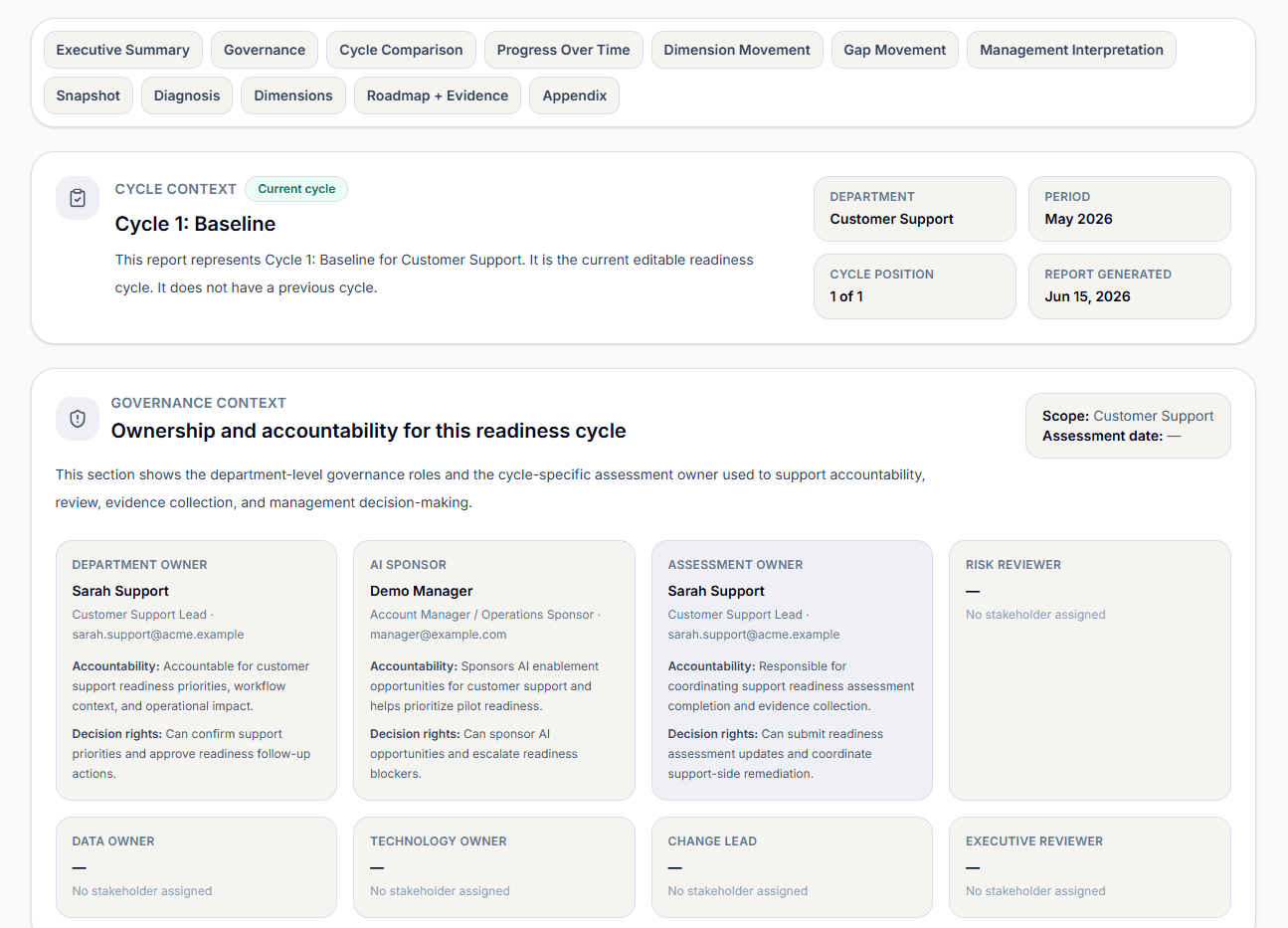
Give leadership a fix-plan view, not another survey result.
Kovalba turns AI adoption into executive questions leaders can actually act on: where are we ready, who needs help, what should move first, what is exposed, and did enablement work?
Kovalba workspace
Why Kovalba
Built for the messy middle between AI awareness and AI operating maturity.
Organizations that have interest, pilots, and scattered experiments need structure before they can scale.
Not an LMS
Kovalba does not try to host courses, videos, or quizzes. It identifies what enablement is needed, for whom, and why.
Not a generic survey
It connects readiness, initiatives, stakeholders, capability dimensions, enablement tracks, and reassessment movement into one operating view.
Built for CXO decisions
The output is not just a score. It is a management view for where to invest, where to slow down, and where to enable people first.
FAQ
Common questions about AI readiness and Kovalba.
What is Kovalba?
Kovalba is an AI readiness assessment and enablement platform that helps professionals and organizations understand AI capability, readiness gaps, governance exposure, and what needs to be fixed before scaling AI-enabled work.
Is Kovalba an LMS?
No. Kovalba is not a learning management system. It does not focus on hosting courses or tracking course completion. It identifies readiness gaps, capability gaps, enablement needs, and practical fix priorities.
Who can use the personal AI readiness assessment?
The personal assessment is designed for professionals who want to understand how ready they are to use AI responsibly in real work, including task framing, workflow thinking, evidence use, human review, governance, and adoption behavior.
How is organizational readiness different from personal readiness?
Personal readiness focuses on an individual’s AI operating capability. Organizational readiness connects people capability with department readiness, AI initiative planning, governance exposure, workshop planning, and reassessment movement.
Can Kovalba help identify what needs to be fixed?
Yes. Kovalba is designed to move beyond scores by showing weak dimensions, readiness blockers, governance exposure, capability gaps, recommended enablement themes, and fix priorities.
Start where you are
Take the personal assessment or run an organizational readiness baseline.
Start individually, then use Kovalba to understand team readiness, department gaps, governance exposure, and the fix plan needed before scaling AI.