
Attendance is easy to count. Capability is harder to prove.
Most organizations are responding to AI adoption in a familiar way: they are training people.
They run AI awareness sessions. They launch prompt-writing workshops. They give employees access to copilots. They publish acceptable-use policies. They encourage experimentation. They celebrate completion rates.
That is not wrong. AI training matters.
But training by itself does not prove that people can use AI responsibly in real work.
This is where false confidence begins. Leaders see training participation and assume the organization is becoming AI-ready. Employees feel more confident because they have been exposed to tools and examples. Teams start using AI more often. But the organization may still have no clear evidence that people can apply AI safely, check outputs, protect data, redesign workflows, escalate risk, or use human judgment when it matters.
The problem is not AI training.
The problem is AI training without capability measurement.
The false-confidence trap
Training produces visible signals. Capability produces operational evidence.
The visible signals are easy to report:
- how many people attended training
- how many completed a course
- how many watched a video
- how many received access to an AI tool
- how many say they feel more confident
Those signals are useful, but they are not enough.
They do not tell leaders whether a user can evaluate an AI-generated answer. They do not show whether someone knows when customer-impacting output needs review. They do not show whether employees understand what data can be used, whether evidence is reliable, or whether a workflow should change before AI becomes part of it.
In traditional learning evaluation, this distinction is well known. The Kirkpatrick model separates reaction, learning, behavior, and results. In other words, liking a training session or learning a concept is not the same as applying the behavior back in the work environment.[1]
AI makes this distinction more important because the risk is not only that training fails. The risk is that training succeeds at increasing confidence faster than it increases judgment.
Why AI training is different from ordinary software training
AI is not just another enterprise tool.
When people learn a spreadsheet feature or a CRM workflow, the task is usually bounded. The system does what the user tells it to do. The main question is whether the user knows the steps.
Generative AI is different. It produces outputs that can look fluent, complete, and confident even when they are incomplete, unsupported, or wrong. It can summarize, draft, classify, recommend, and reason in ways that feel useful but still require human verification.
That means AI training cannot stop at tool usage.
A user does not only need to know how to write a prompt. They need to know:
- when the prompt is poorly framed
- when the source material is insufficient
- when the output needs evidence checking
- when sensitive information should not be used
- when human review is required
- when the task should not be delegated to AI
- when an answer is plausible but not reliable
- when escalation is necessary
This is why AI training without measurement can mislead leaders. It can make the organization look more prepared while leaving the most important behaviors untested.
The adoption gap is already visible
The enterprise AI market is full of activity, but activity is not the same as impact.
BCG’s 2025 AI at Work research found that more than three-quarters of leaders and managers use generative AI several times a week, while regular use among frontline employees has stalled at 51%. BCG also found that companies are realizing that simply introducing AI tools into existing work is not enough; the larger value comes when organizations reshape workflows end to end.[2]
That matters because training often focuses on the first problem: getting people to use AI.
Capability measurement focuses on the second problem: whether people can use AI well enough to change work.
McKinsey’s 2025 State of AI research points in the same direction. It identifies a set of management practices associated with value from AI, including strategy, talent, operating model, technology, data, and adoption at scale. High-performing organizations are also more likely to define processes for when model outputs need human validation.[3]
That is a capability issue, not a training-attendance issue.
The question is not simply, “Did people learn how to use the tool?”
The better question is, “Can people apply AI inside a controlled, evidence-based, human-reviewed workflow?”
The three signals leaders should not confuse
Organizations often confuse three very different signals: exposure, confidence, and capability.
| Signal | What it means | What leaders should know |
|---|---|---|
| Exposure | Someone attended training, saw the tool, or completed the course. | It proves introduction, not readiness. |
| Confidence | Someone feels more comfortable using AI. | Confidence can rise faster than competence. |
| Capability | Someone can apply AI responsibly in real work with judgment, evidence, review, and escalation. | This is the signal organizations need before scaling. |
Training often measures exposure. Surveys often measure confidence. AI readiness requires capability measurement.
What capability measurement should test
A practical AI capability baseline should test whether people can use AI in the conditions that matter at work.
It should measure more than general awareness. It should examine applied behaviors such as:
- Can the user frame an AI-supported task clearly?
- Can the user provide useful context, constraints, and expected output?
- Can the user identify where AI fits into a workflow?
- Can the user distinguish between low-risk and high-risk AI use?
- Can the user verify an AI output against evidence or approved sources?
- Can the user recognize when human review is needed?
- Can the user identify privacy, compliance, or customer-impact risk?
- Can the user escalate uncertainty?
- Can the user explain how AI changes the work process?
- Can the user participate in adoption and improvement over time?
This is the difference between knowing about AI and being able to operate with AI.
The measurement ladder
Organizations need a better ladder for AI enablement. Most AI training programs stop at attendance or basic understanding. Serious AI enablement needs to measure application, behavior transfer, and business or risk impact.
Level 1
Attendance
Who attended the training?
Useful for administration, but not a readiness measure.
Level 2
Understanding
Who understands the concepts?
Shows whether users absorbed basic AI literacy, including limitations, risks, use cases, and policies.
Level 3
Application
Who can apply AI in a practical work scenario?
This is where capability begins: task framing, appropriate use, output review, and limits.
Level 4
Behavior transfer
Who applies the capability back in the work environment?
Learning matters when it changes behavior in the job context.
Level 5
Business and risk impact
Where did AI improve work, reduce effort, increase quality, or expose risk?
Connects people capability to workflow performance, governance, and business outcomes.
Most AI training programs stop at Level 1 or Level 2. Serious AI enablement needs to reach Level 3, Level 4, and Level 5.
What false confidence looks like in practice
False confidence is not always obvious. It often appears as progress.
A department reports high training completion. Employees say they are more comfortable with AI. Managers encourage experimentation. Tool usage increases.
But underneath the surface:
- users cannot consistently verify AI outputs
- teams do not know which tasks require human review
- sensitive data rules are unclear
- workflows have not been redesigned
- managers cannot tell whether AI use improved quality
- employees use unapproved tools when approved tools are inconvenient
- governance exists as policy, but not as daily behavior
BCG’s AI at Work research warned that when employees do not have the AI tools they need, more than half say they will find alternatives and use them anyway. That is a security, governance, and fragmentation problem.[2]
Training alone does not solve that problem. Capability measurement helps reveal it.
Why baseline measurement should come before broad enablement
A baseline gives leaders a starting point.
Without it, AI training is usually generic. Everyone gets similar content, regardless of role, workflow, risk exposure, or current capability.
With a baseline, enablement can be targeted.
Some users may need AI literacy. Others may need prompt design. Others may need data and evidence awareness, human review discipline, workflow redesign, risk awareness, or management oversight.
That distinction matters because AI is not used in the same way by every role. An HR manager, finance analyst, operations lead, customer service agent, legal reviewer, and department head all face different use cases and risks.
A baseline helps answer:
- Who needs foundational AI literacy?
- Who is ready for workflow-level AI application?
- Who needs stronger evidence-checking habits?
- Which teams have weak governance awareness?
- Which managers need oversight training?
- Where should enablement be targeted first?
The goal is not to test people for the sake of testing. The goal is to stop treating the workforce as one generic training audience.
The workforce problem is larger than AI
AI capability measurement also fits into a larger workforce reality.
The World Economic Forum’s Future of Jobs Report 2025 found that skills gaps are the biggest barrier to business transformation, cited by 63% of employers. The report also states that if the global workforce were represented by 100 people, 59 would need reskilling or upskilling by 2030.[4]
That should change how organizations think about AI training.
The challenge is not simply to deliver more learning content. The challenge is to understand which capabilities are missing, where those gaps matter most, and whether enablement is actually moving the workforce.
AI makes that challenge urgent because tools are changing faster than many organizations can redesign roles, workflows, and controls.
The better sequence: assess, enable, reassess
The stronger model is simple.
Assess
Measure current AI operating capability before broad enablement. Identify strengths, weak dimensions, and role-specific gaps.
Enable
Use the baseline to target workshops, coaching, guidance, practice scenarios, workflow redesign, and governance support.
Reassess
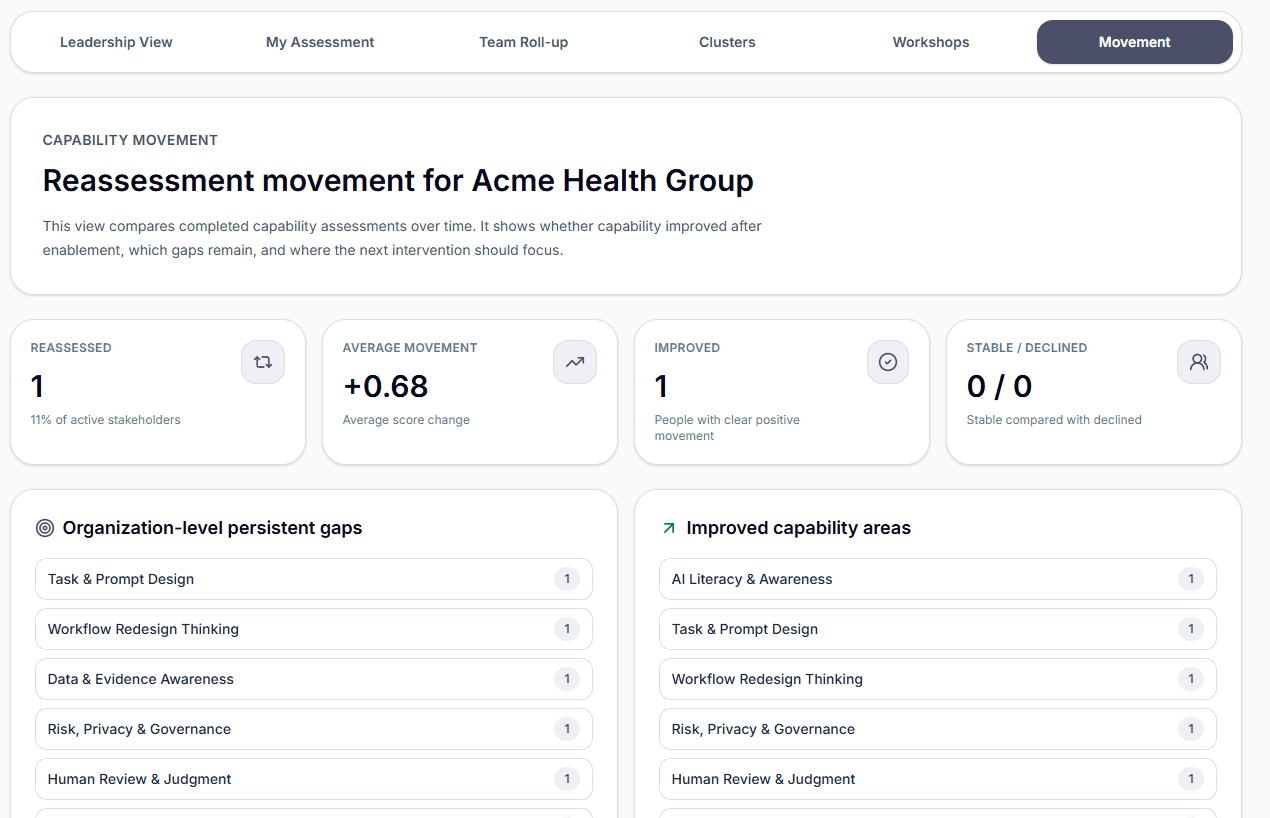
Measure whether capability improved after enablement. Look for movement, persistent gaps, new gaps, and areas where support needs to change.
This turns AI training from an event into a capability-building system.
It also gives leaders something more useful than completion rates. It gives them evidence of movement.
What leaders should measure after training
If training has already happened, the next step is not to run more training immediately. The next step is to measure whether training changed capability.
Leaders should look for evidence in five areas.
01
Task quality
Are users framing AI-supported tasks more clearly?
02
Output judgment
Are users better at reviewing AI-generated content before using it?
03
Evidence discipline
Are users checking outputs against approved sources, data, or expert knowledge?
04
Governance behavior
Are users following privacy, risk, review, and escalation expectations?
05
Workflow application
Are teams changing how work is performed, or are they only using AI as a side tool?
These indicators are more useful than asking whether employees liked the training.
They also connect to responsible AI governance. NIST’s AI Risk Management Framework is intended to help organizations manage AI risks to individuals, organizations, and society — which means capability, review, and risk behavior must be visible in practice, not only described in policy.[5]